Focus on Breakouts From Tight Consolidations
Research · Breakout filters · Tight base
Nearly every systematic trading book pushes the same idea: buy breakouts after expansion. Close above the 52-week high. Close above the upper Bollinger Band. Close above the Donchian channel.
With the right parameters these tend to work, but the return-to-drawdown ratio is usually below 0.5. And the edge has decayed over time.
That's why I stepped away from momentum strategies for a few years.
Then I came across Qullamaggie. His trading looked nothing like my weak textbook setups. His results were hard to ignore. I decided to backtest his approach properly.
But when I tried it, keeping the same breakout logic and only changing the universe to high-ADR top performers, nothing worked. It underperformed even the unfiltered textbook approach.
That's when I started paying closer attention to traders like @RealSimpleAriel, @stamatoudism, and @jfsrev. There was a consistent theme: the stock has to be very tight before it breaks out. That's what finally clicked.
Defining the two breakout types
To test the tightness theory I defined two types of breakouts:
- Breakout after a very tight consolidation
- Breakout after a loose range
Tightness was measured by the distance between the 10, 20, and 50-day moving averages, and by how close price was hugging those MAs going into the break.
Loose breakouts
Equity curve:
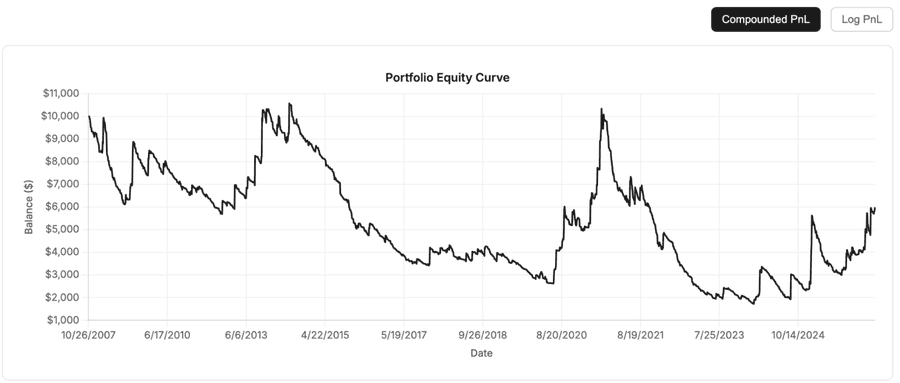
About what you'd expect from a textbook breakout. Returns are weak, drawdowns are deep, nothing you'd want to run real money on.
Tight consolidation breakouts
Same universe. Same entry trigger. Only difference is the stock had to be in a tight base first.
Equity curve:
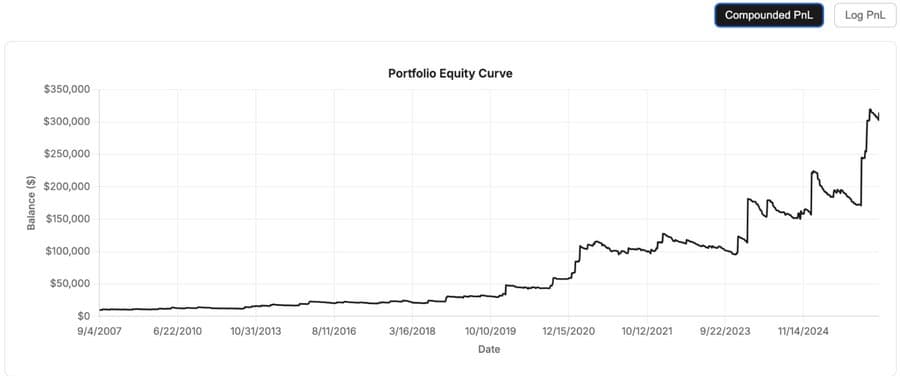
Tightness changes everything.
What this means
The breakout itself is not the edge. What happens before it is.
A tight base means supply has dried up. No more sellers pushing it down. The stock just sits there, coiled. When demand shows up, there's nothing in the way. That's why the move behaves differently from a breakout out of a wide, sloppy range — where overhead supply is everywhere and every push gets sold into.
This guy — @AsymTrading — framed it better than my backtests could:
“One of the biggest misconceptions in trading is that breakouts themselves are the edge. They are not. The real edge lies in what happens before the breakout.”
My reaction at the time: wild how some discretionary traders just know things I need to backtest a thousand times to believe.
The filter cuts the number of valid setups dramatically, which is a real overfitting concern. At the same time, it's exactly what the best momentum traders have been saying for years. That's not nothing.
My algo has been running this live since the start of 2026. I'll have a much cleaner read on it by the end of the year.